01 · 4:27
El Dorado
An Americanized bachata and the gold he leaves behind.
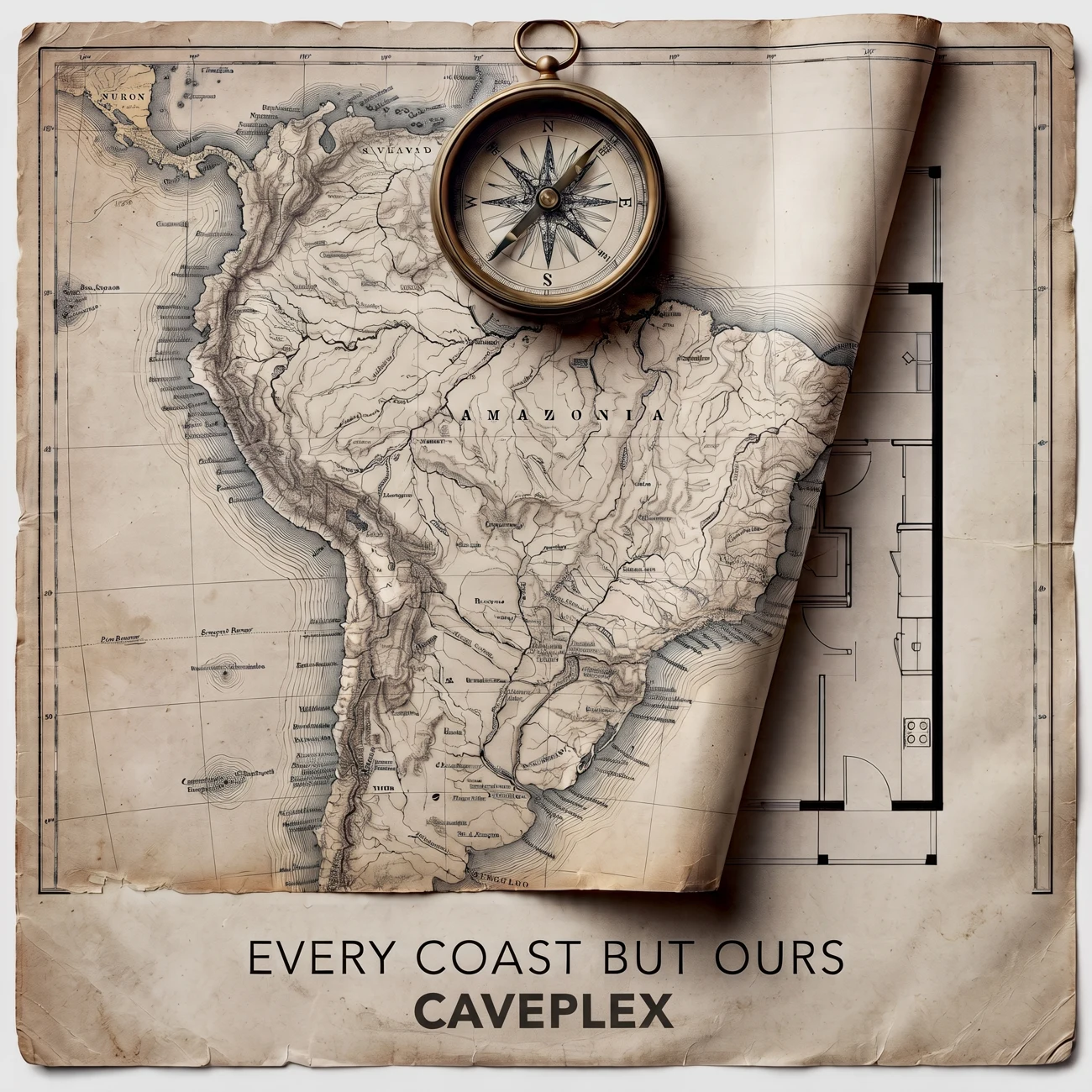
Every distant treasure, every place mapped — and the place right beside us.
About the albumListen to the tracksEvery Coast But Ours can’t be classified as a Latin album. Some tracks carry a Latin rhythm: a bachata on “El Dorado”, a reggaetón on “Twenty Seconds”, a cha-cha-chá on “The Cartographer”, a samba on “Apagón”. Each one is diluted until it reads as alternative and indie first, with the original form still audible underneath. Other tracks take different paths. “The Bottom of the Stairs” uses a modern reggae beat; “Atlantis Never Sank” draws on Afro-Latin polyrhythms. “The Fire We Carried” leans on flamenco. “Past the Last Stop” is storytelling Americana with no foreign influence. The voice stays the same across all of it: restrained, close, and sung in English.
The lyrics return to the same choice. A man looks for El Dorado and gives up the gold; the record moves through Atlantis, a lost map, and a cartographer who charts the whole world. Yet each song returns to something small: fireflies in a jar, two chairs on a step during a blackout, a cup on a counter after a bad year. “Twenty Seconds” says: “I don’t need El Dorado. / I don’t need the sunken town.” The album title comes from “The Cartographer”: “Every coast on earth. / Every coast but ours.”
Some English lyrics carry one Spanish word: luciérnagas, la nieve, brasa, apagón.
The music was produced with Suno. Lyrics, structure, and direction of each track are by Caveplex.
Continuous play: after one track ends, the next begins.
An Americanized bachata and the gold he leaves behind.
Fireflies, release, and a new kind of treasure.
A lighthouse keeper and the stranger climbing his stairs.
A submerged city and an uncle’s impossible map.
Havana, a faraway winter, and an unexpected orchestra.
Every coastline mapped, except the nearest one.
Three winters and the one ember that survives.
A blackout, a guitar, and two chairs on a step.
The opening theme, now without words.
Select a song to expand its meaning and complete lyrics; open another to switch tracks.
An Americanized bachata, opened into ambient pop and world textures. A man enters the jungle in search of gold, meets a woman who explains that the treasure is not there, and throws away his map. This is the album’s starting point.
A modern reggaetón. Someone catches fireflies in a jar on a summer night and releases them at midnight: “You can’t keep something / Just because it’s beautiful.” The bridge looks back on the album’s treasure stories and refuses them. The final chorus switches to Spanish on luciérnagas.
Not a happy reggae: a passionate song on a modern reggae beat, supported by some of the album’s most complex chords. A lighthouse keeper has kept a light burning for strangers for forty years. Then someone climbs his stairs and asks who he is.
Afro-Latin polyrhythms treated as alternative and indie. An uncle sells maps by the pier and claims he once saw a gold dome at dawn. At low tide the narrator finds a street beneath the water and hears bells. “Atlantis never sank / It only learned to hide.”
Heavily produced storytelling Americana, with no foreign musical influence and unexpected orchestral accents. A man is sent from Havana to a village nine hundred past the last train stop. He meets a woman who belongs to someone else, tells her about the sea each evening, and stays the winter. A long instrumental interlude closes the song.
A cha-cha-chá about a man who could map the entire world and put a label on everything, but was never able to map his own heart. “Every place got labeled. / Every place but me.” The song breaks its own structure to match: the tempo shifts, the final chorus never comes, and the voice stops on “Nobody but you.” The music finishes alone.
A slow, flamenco-influenced song that turns sad and stays there. Three hard winters take the money, the car, and the conversation, but two people protect one brasa through the year. “They say love’s a lightning strike, / It’s not. It’s a coal.”
Samba-based rhythm given an alternative-pop treatment. During an August blackout, the neighborhood comes outside, someone finds a guitar, and the narrator sits beside someone he does not want to leave. It is not the biggest night; it is the one remembered: “Leave the porch light off. / Sit back down.”
The opening theme returns without lyrics. This instrumental journey closes the circle, taking the record back to where it began.