

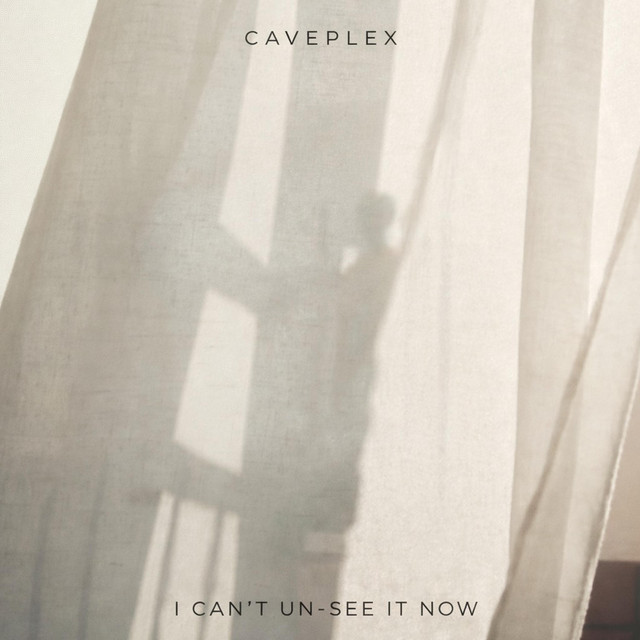
Release: I Can’t Un-see It Now
Type: Single
Date: 2026-04-01
Caveplex — “I Can’t Un-see It Now” (single, 2026-04-01)
“I Can’t Un-see It Now” is a study in the violence of small perception — a song about the moment when a familiar room, a familiar face, a familiar silence stops being readable the way it used to be. Where many songs about suspicion or betrayal reach for confrontation, this one stays inside the aftermath of a single shift in awareness, cataloguing the wreckage left behind not by an event but by a new way of seeing. It is a precise and unsettling piece of domestic observation.
Likely intention behind the lyrics
The song appears to be concerned with the irreversibility of interpretation — specifically, the moment when context rewrites everything that came before it. Something has been said or revealed, and though nothing in the physical world has changed, the speaker can no longer inhabit it neutrally. The likely intention is not to dramatize conflict but to render the cognitive and emotional state that follows: a hypervigilance in which ordinary gestures — a hand touching hair, a half-smile, fingers resting too still on wood — become charged with potential meaning. The song seems interested in the question of whether that new meaning was always latent or whether perception itself has become the contaminant.
Section-by-section interpretation
Opening inventory (first stanza):
Door didn’t slam
Just clicked, same hallway
Same crooked frame
Same junk mail
The song opens with a refusal of drama. Nothing slammed. The hallway is the same. The crooked frame, the junk mail — these are the residue of ordinary life, listed flatly as if to insist on their ordinariness. But the very insistence signals that ordinariness can no longer be taken for granted. The speaker is cataloguing sameness with a new anxiety, the way a person checks for something missing without knowing exactly what they’re looking for.
The inciting shift (second stanza):
You said one thing
Thin paint, soft spin
Every picture stayed
But the faces shifted
Here the rupture arrives — understated, almost buried. “You said one thing.” The phrase is deliberately minimal, withholding the content of what was said. What matters is the effect: “thin paint, soft spin” suggests a surface-level explanation, a careful framing, something that tried to pass itself off as neutral. And yet it was enough. The pictures stayed on the wall. Nothing moved. But the faces in them look different now.
Chorus — the new condition:
Nothing feels neutral now
Everything’s way too loud
Same four walls
I can’t un-see it now
The chorus names the state without explaining it — a sensory overwhelm inside an unchanged space. “Everything’s way too loud” is not about sound so much as signal: the world has become over-legible, every detail suddenly demanding interpretation. “Same four walls” anchors the experience in physical stillness even as the internal landscape has shifted completely. The title phrase lands as both admission and lament — the speaker is not accusing, merely reporting a loss of innocence that cannot be reversed.
Reading the body (third stanza):
You touch your hair
I read it different
That half-smile
Falls in a different way
Fingers on wood
Too still, too steady
Was it always there
Or did I just see
This is the song’s most forensic passage. The speaker has become an involuntary interpreter of gesture — hair, smile, the stillness of fingers on a surface. Each detail is now a potential sign. “Too still, too steady” carries a particular unease: stillness that was once unremarkable now reads as deliberate, as concealment. The stanza ends on an incomplete sentence — “Or did I just see” — the thought cut off before its object, as if the speaker cannot yet name what it is they think they’ve seen.
The question of origin (final stanza):
I used to drift
Inside this silence
Now every pause
Comes back marked
Was it always there
Under what we said
Or did it wake tonight
And stay
The final section moves the inquiry inward and backward in time. The speaker used to drift in silence — that silence was safe, ambient, unremarkable. Now every pause is “marked,” retroactively annotated. The central question — “Was it always there / Under what we said / Or did it wake tonight / And stay” — is the song’s deepest and most unresolvable knot. It cannot be answered. What the speaker is left with is not knowledge but the permanent inability to return to not-knowing.
Recurring images, tensions, and symbols
The song builds its world from the deliberately unspectacular: hallways, junk mail, crooked frames, four walls, wood surfaces, a half-smile. These are the textures of cohabitation and routine, chosen precisely because they should mean nothing — and now mean everything. The recurring tension is between sameness and altered perception: the physical world is unchanged while the interior world has been irrevocably rewritten.
Silence and noise operate as dual registers throughout. Silence was once a place of ease; now it is where suspicion pools. Loudness is not external but perceptual — the overstimulation of a mind that has lost the ability to triage. Gesture becomes language in the song’s central section, the body read as text in a way it never had to be before. The incompleteness of the line “Or did I just see” mirrors the incompleteness of the speaker’s understanding — the sentence stops because the thought cannot close.
What the song seems to mean overall
“I Can’t Un-see It Now” is a song about the cognitive aftermath of a small revelation — a song about what happens to a familiar life once a crack appears in it. It does not moralize or assign blame. It stays inside the experience of disrupted perception with unusual fidelity, tracking the moment when domestic space becomes unreadable and when another person’s most ordinary gestures become evidence in a case that may never be resolved. The final question — whether what the speaker now sees was always present or has only just arrived — is left open. The song seems to understand that this is exactly the question that cannot be answered, and that the inability to answer it is precisely what makes it impossible to stop asking.
Lineages, moods, and artistic traditions
The song belongs to a tradition of interior miniaturism — art that finds catastrophe in the close observation of small domestic facts. It shares sensibility with lyric poets who have used household objects and bodily gesture as the terrain for psychological drama, and with songwriters for whom restraint of language amplifies rather than diminishes emotional stakes. The flat, declarative opening — “Door didn’t slam / Just clicked” — echoes a mode of deadpan precision that trusts the listener to feel what the speaker refuses to overstate.
Its mood sits somewhere between the forensic and the elegiac: the speaker is both detective and mourner, sifting through the same evidence repeatedly without resolution. The absence of narrative resolution places it among works more interested in states of mind than in events — pieces that render the texture of an experience rather than its arc. In this sense, “I Can’t Un-see It Now” is less a song about what happened than a song about what it feels like to live inside a perception you cannot put back.
It closes the album on a note of quiet, unresolved vigilance — a room that looks the same, a person who looks the same, and a speaker standing inside all of it, permanently changed by a thing that left no visible mark.
Lyrics
Door didn't slam
Just clicked, same hallway
Same crooked frame
Same junk mail
You said one thing
Thin paint, soft spin
Every picture stayed
But the faces shifted
Nothing feels neutral now
Everything's way too loud
Same four walls
I can't un-see it now
You touch your hair
I read it different
That half-smile
Falls in a different way
Fingers on wood
Too still, too steady
Was it always there
Or did I just see
Nothing feels neutral now
Everything's way too loud
Same four walls
I can't un-see it now
I used to drift
Inside this silence
Now every pause
Comes back marked
Was it always there
Under what we said
Or did it wake tonight
And stay
Nothing feels neutral now
Everything's way too loud
Same four walls
I can't un-see it now