

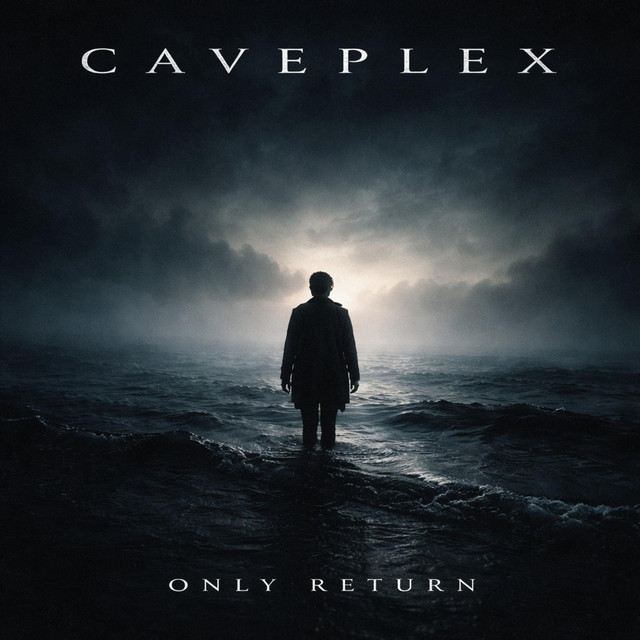
Release: Only Return
Type: Single
Date: 2026-03-22
New Release: Only Return — framing a compact, insistent new single (Caveplex, 2026-03-22)
Caveplex’s new single “Only Return,” released 22 March 2026, presents itself less as a narrative and more as a ritualized statement: a tightly wound repetition, a probing question, and two short sequences of images that push the song from a state of uneasy hesitation into a resigned inevitability. The piece reads like an incision — brief, taut, and deliberately elliptical — and it rewards a close, line-by-line attention to how its language stages compulsion, origin, and the impossibility of simple refusal.
What the lyrics seem intended to do
Rather than building character or situating a story in the traditional sense, the lyrics appear intended to evoke a psychic condition: an impulse or force that predates conscious choice and that continues to call people back. The repeated phrase
Only Return,
Only Return.
What does it want?
Only Return.
works like an incantation and an interrogation at once — it both names the motion and asks for its motive. The effect is to displace agency: the language implies that the subjects are not deciding to move so much as responding to an older current. In that way, the song treats return as phenomenon rather than plot point, and the lyric’s economy intensifies its ritual quality.
Section-by-section reading
Opening refrain
The opening block of repetition sets tone and question simultaneously. The phrase “Only Return” functions as a noun and a command, and the insertion of the direct question — “What does it want?” — refuses closure. The refrain’s brevity and recurrence fixate attention on meaning rather than context; we are forced to attend to what “return” might signify rather than where or when it happens.
First verse
They moved before the morning formed,
Before the world had chosen sides.
No map was drawn, no warning burned,
Just that old current from inside.What called them once
Was still inside.
These lines suggest motion that precedes structure. “Before the morning formed” and “before the world had chosen sides” place the action prior to demarcations — moral, political, temporal — that typically organize human behavior. The absence of a “map” or a “warning” emphasizes the unpremeditated nature of the movement; there is no external plan, only an interior drive: “that old current from inside.” The phrase “What called them once / Was still inside” implies continuity — something ancestral or habitual that persists — and it narrows the field of explanation toward an inward, perhaps hereditary or remembered, cause.
Second verse
The air grew tight, the distance thinned,
The undertow became the guide.
Too deep now for a borrowed shape,
Too late to turn the blood aside.What rose below
Would have its way.
In the second verse the mood intensifies from precursory motion to inescapable force. Atmospheric compression (“The air grew tight”), spatial proximity (“the distance thinned”), and the transformation of an undercurrent into active agency (“The undertow became the guide”) together close off alternative routes. “Too deep now for a borrowed shape” reads as a rejection of disguise or adaptation — something natural or original has overwhelmed any synthetic persona. “Too late to turn the blood aside” brings the somatic into the moral: blood as lineage, impulse, and inevitability. The closing couplet, “What rose below / Would have its way,” is an almost mythic pronouncement of ascendancy; the subterranean — repressed impulse, remembered call, corporeal inheritance — asserts itself.
Recurring images, tensions, and emotional movement
- Water and current: The “current,” “undertow,” and imagery of depth create a hydraulics of will — motion that is both physical and metaphorical. Water here is less placid than inevitability; it is erosive and directional.
- Inside vs. outside: Repeated contrasts between interior drives and external maps or warnings stage a tension between subjective compulsion and the world’s structures. The song privileges inner forces as the true determinants of action.
- Formation and pre-formation: Phrases that place movement “before the morning formed” or “before the world had chosen sides” introduce a temporal register that suggests origin or origin myths, implying acts that predate moral frameworks.
- Bodily language: “Blood” anchors the metaphors in the body and suggests heredity, violence, or passion; it complicates return by giving it anatomical urgency.
- Tension between question and declaration: The central refrain alternates between asking “What does it want?” and repeating the imperative. That oscillation produces both curiosity and fatalism: the lyric both seeks an answer and insists on the action’s necessity.
Emotionally, the song moves from a detached, almost observational opening to a tightening dread and then to a resigned concession. The language of compression and depth (“air grew tight,” “too deep now”) converts curiosity into inevitability. The emotional arc travels from wonder to recognition to submission.
What the song seems to mean overall
Read together, the fragments suggest that “Only Return” is about recurring, perhaps ancestral impulses that compel movement or reunion irrespective of conscious deliberation. The song seems less concerned with the polarity of good or bad and more with the inescapability of certain forces that shape collective or individual behavior. “Return” operates as a motif for cycles — of migration, memory, habit, or even trauma — that persist beyond maps, warnings, or borrowed identities. The final image — whatever “rose below” having its way — proposes that subterranean origins eventually dictate outcomes, and the repeated question underlines the song’s interest in motive over consequence.
Comparisons: lineage and mood without name-dropping
Formal elements in the lyric place it in a tradition that values economy, ritual repetition, and the evocation of elemental forces. The use of a short repeated refrain functioning like an incantation aligns the song with poetic forms that rely on mantra and constraint to produce meaning through variation rather than exposition. Its maritime and subterranean imagery ties it to a broader cultural language in which bodies of water commonly stand in for memory, desire, or fate. Similarly, the lyric’s compression and emphasis on mood over narrative recall tendencies in modern minimalism and in strands of songwriting that favor atmosphere and ethical ambiguity over linear storytelling.
Stylistically, the piece trades exposition for emblematic lines; its strategy is to summon a field of associations and then leave those associations in productive tension. In that regard it shares affinities with artistic practices that prioritize the accumulation of recurring motifs and withholding of explicit explanation, trusting the listener to supply context from experience or intuition.
Closing thoughts
“Only Return” is spare but not simple. Its repeated lines and concentrated imagery create a persuasive logic: that the forces which call us are often older and more physical than the categories we use to make sense of them. The song’s power comes from its refusal to narrate fully, instead staging a compressed drama of impulse and consequence — and from the way its few recurring images (current, undertow, blood, interior calling) gather into an argument about the primacy of what lies beneath the surface.
Lyrics
Only Return,
Only Return.
What does it want?
Only Return.

They moved before the morning formed,
Before the world had chosen sides.
No map was drawn, no warning burned,
Just that old current from inside.

What called them once
Was still inside.

Only Return,
Only Return.
What does it want?
Only Return.

The air grew tight, the distance thinned,
The undertow became the guide.
Too deep now for a borrowed shape,
Too late to turn the blood aside.

What rose below
Would have its way.

Only Return,
Only Return.
What does it want?
Only Return.