

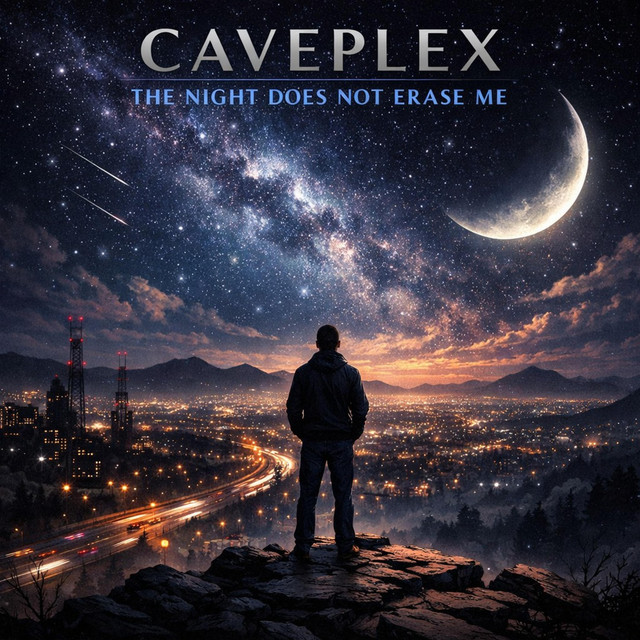
Release: The Night Does Not Erase Me
Type: Single
Date: 2026-03-20
Caveplex — “The Night Does Not Erase Me” (single, 2026-03-20)
Caveplex’s new single, “The Night Does Not Erase Me,” arrives as a concise meditation on scale, belonging, and surrender. In just a few short verses and refrains the song stages a movement from urban tension toward a quieter accommodation: not resignation so much as a reorientation of self within a larger and indifferent space. The piece reads like a lyric essay set to music, one that negotiates the smallness of individual claim against the enlarging anonymity of nocturnal cityscapes.
Likely intention behind the lyrics
The lyrics repeatedly return to ideas of measure, room, and the relationship between what contains us and what we contain. Rather than insisting on an autobiographical claim, the song seems intended to model a psychological adjustment—teaching attention to how environments reshape us and how deliberate acceptance can be restorative. It offers consolation by reframing loss or diminishment as integration: the night does not erase, it relocates. That interpretive stance is offered tentatively; the words allow for multiple emotional readings, but the prevailing impression is one of calm offered against earlier anxiety.
Section-by-section reading
Verse 1
“City lights recede / Signal towers fade / The vaulted obscurity / Outlives our hours” sets the scene in a deliberately emptying urban night. The images compress the cityscape into elements of signal and vault—technology and architecture—then counterpose them with a “vaulted obscurity” that persists beyond human schedules. The language implies a transfer of sovereignty: human time is transient, while a larger darkness endures. The verse reads as a relinquishment of human temporality to a broader, impersonal field.
City lights recede
Signal towers fade
The vaulted obscurity
Outlives our hours
Hook
The hook—“A kinder measure / Not everything is mine”—functions like a thesis statement. It introduces two related ideas: the hope for gentler judgement (“kinder measure”) and the practice of relinquishing ownership. This couplet reframes what might be perceived as loss into an ethical stance: measuring oneself more leniently by acknowledging limits of possession or control. The concise phrasing suggests this is less a dramatic revelation than a quiet, repeatable maxim.
A kinder measure
Not everything is mine
Chorus
The chorus is both the emotional hinge and the clearest statement of the song’s central paradox:
What towers over me
Also makes room for me
The night does not erase me
It puts me where I fit
Here the “tower” that previously implied scale and dominance becomes simultaneously sheltering or accommodating. Where the verse emphasizes the night’s magnitude, the chorus suggests that magnitude does not annihilate the self but instead repositions it into an appropriate, perhaps more honest, place. The repeated clause “The night does not erase me” is defensive yet relieved—defensive against being swallowed and relieved by being re-situated.
Verse 2
“Headlights turn to trace / Window-glare gives in / What keeps wheeling on / Loosens what I grip” continues the motion from solid objects to traces and from grasping to loosening. Mechanical, directional images—headlights, wheels—become less assertive, transforming into faint marks. The world’s forward propulsion, instead of forcing a person along, becomes an agent that relaxes internal tension. This verse makes explicit the mechanism by which the “kinder measure” is achieved: not by battling the night but by allowing its ongoing motion to ease human clutching.
Headlights turn to trace
Window-glare gives in
What keeps wheeling on
Loosens what I grip
Bridge
The bridge functions as an ethical clarification: “No contest with the night / No need to overstate / I let the sky be larger / And keep my human weight.” Acceptance is framed not as self-obliteration but as humility. The speaker refuses a contest and explicitly permits an external scale (“let the sky be larger”) while retaining “human weight”—a groundedness that preserves personal gravity within a vaster context. This passage balances ontological smallness with emotional legitimacy.
No contest with the night
No need to overstate
I let the sky be larger
And keep my human weight
Outro
The outro returns to the hook and chorus language, converting the earlier moves into a refrain that has now taken on ritual weight. Repetition here feels like adoption: the ideas are not merely observed; they are rehearsed into habit.
A kinder measure
Not everything is mine
The night does not erase me
It puts me where I fit
Recurring images, tensions, symbols and emotional movement
Certain images recur with altered emphasis: towers and headlights that once might signify control become diminished into “room” and “trace.” Night functions simultaneously as an antagonist and an environment; it is both the overpowering scale and the agent by which the speaker finds placement. There is a persistent tension between grasping and loosening, ownership and allowance, human-scale time and nonhuman duration. Emotionally, the song moves from the unease of being small in a big city toward a tempered peace—an acceptance that is active and conscious, not passive erasure.
- Night as a double-edged symbol: menace and enclosure that makes space.
- Light and mechanized motion (signal towers, headlights, wheels) as temporary coordinates that yield to larger obscurity.
- A moral vocabulary of measure, room, and weight that frames psychological recalibration as ethical practice.
What the song seems to mean overall
At its core, “The Night Does Not Erase Me” reads as a meditation on how scale reorganizes identity. The speaker negotiates a kind of humility that is not defeatist: to accept that not everything belongs to you is to open toward a “kinder measure” that permits reorientation. The song proposes that anonymity or diminution under a vast sky need not be traumatic; it can be a corrective, a way to “fit” rather than to insist on disproportionate claims. In that sense the track offers an ethic of proportion—the idea that living well involves recognizing limits and finding comfort in re-placement rather than erasure.
Comparative lineages and moods
This single participates in a tradition of nocturnal urban reflection and restrained lyric minimalism without relying on borrowed signatures. Its sensibility aligns with works where city nights are used as liminal spaces for recalibration—places where social spectacle fades and interior reckoning becomes possible. Musically and lyrically, the song favors understatement over catharsis: spare statements, repeated refrains, and a quiet narrative arc that privileges atmosphere and aperture over dramatic closure.
Formally, the track echoes a lineage that prizes concision and spaciousness—songs that allow images to hang and accumulate meaning through repetition and small shifts. The effect is to turn the city’s scale into a moral and emotional instrument: anonymity becomes a means of sifting what truly matters. That lineage includes practices in songwriting and poetry that use night and urban architecture as metaphors for perspective, where the task of the artist is not to conquer the scene but to translate its relational value for the listener.
Conclusion
“The Night Does Not Erase Me” is less an argument than a practice: a short, careful lesson in letting go and finding placement. Its strength lies in restraint—the way it describes large things without grandiosity, how it permits the night to be both indifferent and tender. Listened to attentively, the song proposes a modest antidote to anxiety: not by amplifying the self but by recognizing how larger structures can, paradoxically, make room for it.
Lyrics
[Verse 1]
City lights recede
Signal towers fade
The vaulted obscurity
Outlives our hours

[Hook]
A kinder measure
Not everything is mine

[Chorus]
What towers over me
Also makes room for me
The night does not erase me
It puts me where I fit

[Verse 2]
Headlights turn to trace
Window-glare gives in
What keeps wheeling on
Loosens what I grip

[Hook]
A kinder measure
Not everything is mine

[Chorus]
What towers over me
Also makes room for me
The night does not erase me
It puts me where I fit

[Bridge]
No contest with the night
No need to overstate
I let the sky be larger
And keep my human weight

[Outro]
A kinder measure
Not everything is mine
The night does not erase me
It puts me where I fit