

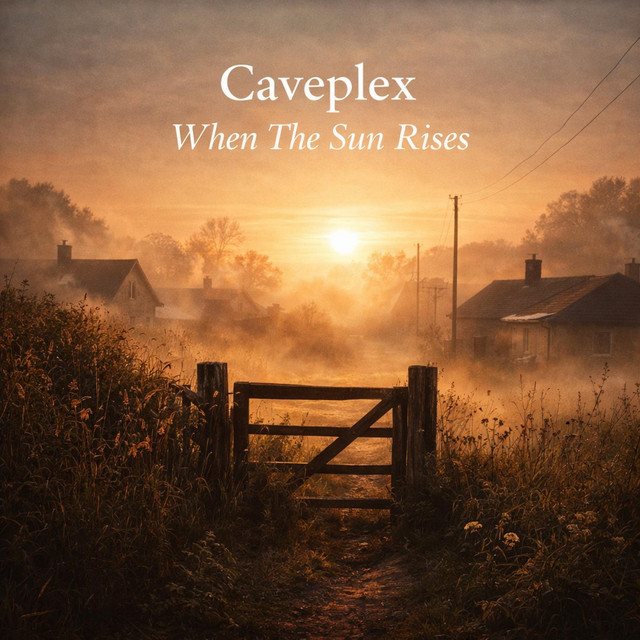
Release: When The Sun Rises
Type: Single
Date: 2026-03-26
Listen to “When The Sun Rises”
Caveplex’s new single “When The Sun Rises,” released 2026-03-26, arrives as a compact, austerely phrased meditation. It reads like a short lyric poem set to music: spare images, repeated refrains and a restrained, almost ritual logic. The song’s economy—brief lines, recurring couplets, a steady return to the titular stanza—creates a space where description and inference are deliberately entangled. Rather than narrating a discrete story, the lyric accumulates particulars that gesture toward aftermath, continuity and the uneasy negotiation between loss and renewal.
On likely intention
Given the lyric’s focus on physical traces (smoke, dust, rust) and cyclical markers (fields, grain, the sun itself), the song seems intended to probe how human life persists in the wake of disruption. The repeated assertion that “When the sun rises / The sequence aligns” reads less like reassurance than a sober observation: dawn brings order, but that order may simply be the continuation of processes that are indifferent to human suffering. Lines such as “No name for the silence / No weight for the prize” suggest the lyric aims to articulate the limits of language and value in the face of what remains unmeasured—grief, aftermath, perhaps historical consequence. The overall posture is contemplative rather than declarative; it invites interpretation rather than offering a single read.
Section-by-section reading
Opening frame: thresholds and scorched detail
Frame in the doorway / Fields turning gold / Black smoke on rooftops / Dust on the road
The song opens with a scene set at a threshold—”frame in the doorway”—which immediately introduces the vantage point of observation. The pairing of “fields turning gold” with “black smoke on rooftops” juxtaposes harvest-time abundance and signs of combustion or damage. “Dust on the road” compounds the sense of disuse or dislocation. Together these lines create a landscape that is both productive and wounded; the viewpoint is intimate but outward-facing, registering the local consequences of a larger disturbance.
First pause: silence and prize
No name for the silence / No weight for the prize
The two-line interjection that follows the opening image functions like an elegiac aside. “No name for the silence” suggests an experience that resists categorization—an unnameable absence. “No weight for the prize” implies that whatever reward or resolution might have been expected is unmeasurable or insufficient. This couplet introduces the song’s central tension between experience and language, between expectation and valuation.
Refrain as cosmology and ritual
When the sun rises / The sequence aligns / Over the houses / Over our lives
The refrain recurs as a kind of incantation. It reads simultaneously as cosmic statement and procedural observation: the rising sun resets some larger order—”the sequence aligns”—that overlays private, domestic spheres (“houses” and “our lives”). The repetition diminishes rhetorical urgency and increases liturgical resonance; the line’s blankness makes it function like a hinge between natural continuity and human contingency.
Second image set: decay and restitution
Rust on the gatepost / Shadow on fence / The earth giving back now / After the wrench
Here the lyric shifts attention to objects of slow change—rust, shadow—and to the idea of restitution or response: “The earth giving back now / After the wrench.” The “wrench” is ambiguously scaled: it could mean a wrenching event, a mechanical instrument, or an emotional wrench. The phrasing suggests that the environment is not merely a passive backdrop but is actively responding, returning or reclaiming. That responsiveness complicates the earlier sense of indifferent sequence; there is an active reciprocity at work.
Weight and warmth
The morning is heavy / The warming is same
These lines compress contradiction into two short clauses. Morning, which commonly connotes lightness, here bears weight. The “warming is same” suggests continuity—temperature rises but meaning or relief does not necessarily shift. The tension between heaviness and the literal warming of dawn points to a persistent ambivalence: change is happening, but its moral or emotional valence remains unsettled.
Final stanza: expansion of scale and renewal
When the sun rises / The sequence aligns / Over the houses / Over our lives / Over the child grown / Over the grain / Over the pulse-point / Starting again
The refrain returns and broadens to include generational and bodily scales—”child grown,” “grain,” “pulse-point”—culminating in “Starting again.” This telescoping enlarges the frame from household to lineage and organism. The “pulse-point” adds an anatomical intimacy to the landscape images, linking cosmic recurrence with embodied continuity. The final “Starting again” can be heard as both literal rebirth and a bleak note of repetition: cycles resume, for better or worse.
Recurring images, tensions and symbols
Several motifs recur and accrue meaning through repetition:
- Light and sequence: The sun and the phrase “sequence aligns” function as organizing metaphors for renewal, order and inevitability.
- Domestic and agrarian details: Houses, gateposts, fences, fields and grain anchor the lyric in lived, everyday materiality and suggest a community or rural setting.
- Signs of damage and recovery: Black smoke, dust, rust and “the wrench” introduce trauma and physical alteration, while “the earth giving back” gestures at recuperation or restitution.
- Silence and valuation: The opening couplet about silence and prize frames the song’s ethical inquiry—what can be named and what can be weighed in the wake of change?
Tension runs between cyclical inevitability (the sun, sequence) and the specificity of loss (smoke, rust, silence). The lyric resists consolatory closure; its repeated lines work like liturgical refrains that both soothe and record an inability to fully account for what has occurred.
What the song seems to mean overall
As a whole, “When The Sun Rises” reads as a meditation on continuity after rupture. It does not offer a narrative explanation of the cause of dislocation; rather, it dwells on the texture of aftermath—how the world looks and feels when familiar markers persist but their meanings have shifted. The song seems to argue that human life is nested within larger rhythms that continue regardless of our recognition, yet those rhythms do not erase the traces of upheaval. The lyric’s restraint—its refusal to over-clarify—feels purposeful: it acknowledges the limits of naming and measuring while still insisting on attention to the particulars of place and body.
Lineage and artistic traditions
The track works in a lineage that privileges spare, imagistic lyricism and the repetition of refrains as a way of making meaning through accumulation rather than exposition. It sits beside traditions of pastoral elegy—poems and songs that juxtapose rural detail with mourning—and also resonates with forms of minimalist lyric where repetition becomes ritual. There is a sensibility here that treats landscape as interlocutor and witness: the environment records and responds, and the human speaker is partly a receiver of that testimony. Musically or tonally, the song’s economy recalls approaches that favor atmosphere and elliptical statement over storytelling, relying on small gestures to convey moral and emotional freight. This isn’t homage in the sense of mimicry; rather, it participates in a set of strategies—restraint, repetition, concentrated detail—that have long been used to register loss, survival and the ambiguous solace of routine.
Concluding note
“When The Sun Rises” does not resolve its own questions, and that may be its central point. By balancing domestic specificity with elemental recurrence, Caveplex crafts a lyric that feels observational and ethical at once. The song invites listeners into an attentive register where naming fails and noticing remains urgent: the sun will rise, sequences will align, but the work of living through what has happened continues.
Lyrics
Frame in the doorway
Fields turning gold
Black smoke on rooftops
Dust on the road

No name for the silence
No weight for the prize

When the sun rises
The sequence aligns
Over the houses
Over our lives

Rust on the gatepost
Shadow on fence
The earth giving back now
After the wrench

The morning is heavy
The warming is same

When the sun rises
The sequence aligns
Over the houses
Over our lives

No name for the silence

When the sun rises
The sequence aligns
Over the houses
Over our lives
Over the child grown
Over the grain
Over the pulse-point
Starting again