01 · 3:44
You Put It On Me
Private blame, public echoes.
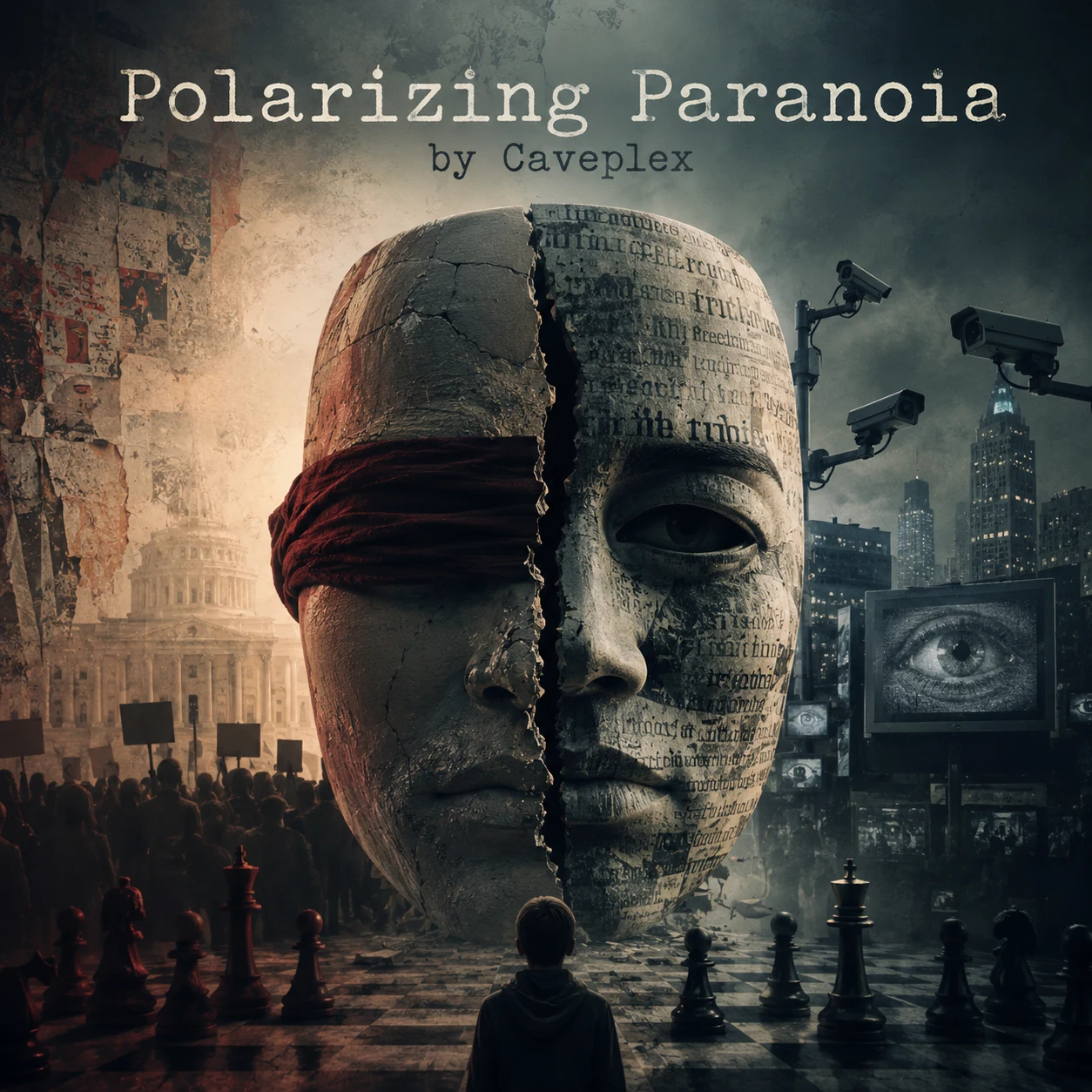
A political theme. Eight independent stories. An observer's point of view.
About the albumListen to the tracksPolarizing Paranoia is a political album with no overarching concept or continuous story. Eight songs share a theme: what division does to a room, to a family, and to the person caught in the middle.
Most of the album watches instead of preaching. The title track hears cable news in an elevator and sees phones glowing “like a jury box”. Split The Room begins with two kids at a bus stop and a single word. The political world appears through small, ordinary scenes; the lyrics rarely tell the listener what to think.
The personal and the political sit close together. Several songs begin with one person's experience of blame, labels, or pressure, then widen to the public version of the same thing. Others remain personal throughout.
The album ends on its most direct track. I'm Breaking Free Now changes the observational voice for an anthem chorus, the one song intended to be sung back.
The music was produced with Suno. The lyrics, structure, and direction of every track are by Caveplex.
Continuous play: after one track ends, the next begins.
Private blame, public echoes.
Time, ageing, and systems we did not write.
A room divided, the middle disappearing.
A return measured in persistence, not symbols.
Owning the damage instead of moving the blame.
An identity someone else tries to assign.
One word travels from a bus stop to a family.
The closing anthem, meant to be answered.
Select a song below to expand its meaning and complete lyrics. Open another to switch tracks.
You Put It On Me. A song about projection, personal first and then political. Someone hands the narrator their own disorder and calls him by its name: “You put it on me / Then called me by its name.” He carries it in private for years, until he learns to recognise the move on sight. In the third verse, he hears the same method “on podiums and screens”: a face picked out to carry the blame, an enemy passed around as proof. “The same old relocation / Just scaled and dressed as state.” The song ends where it began, back in the personal. The track opens restrained on danzón and tango. Then the interlude turns into a modern, Americanized guaracha with a female soprano, and its playfulness answers the lyric: whatever you project, I’m not carrying it.
The quietest song on the record. Time stops being something ahead and becomes something arriving every day. The second verse looks outward: “We age into systems / We didn't design.”
The title track watches a room split in half: some want theatre and others want someone to blame, while everyone remains polite. The bridge becomes a series of brief, cold images, ending on the observation: “Watch how fast the middle falls.”
An office clock runs out of step with the narrator's own time; while he sleeps, somebody redraws the map. The answer is neither a monument nor a flag. It is that he came back through, every time.
The one song where the narrator directly accepts responsibility. He says the wrong thing first, then tries to relocate the blame. The turning point is the line: “This didn't break itself.”
The shortest lyric on the album begins with wordless vocals, then pictures ground shifting under borrowed names. Its refusal is quiet but firm: “I don't answer to their language.”
Written in the idiom of teenagers and group chats — “bet”, “nah”, “bruh” — it follows one word from a bus stop to a phone and into a family. It is the one track that suggests a possible way out: hearing more.
The closing anthem exchanges observation for declaration. Written in second person with a call-and-response chorus, it ends on “I'm finally free.”