

The Island of the Blue Crabs – A Short Science Fiction Story
The island didn’t appear on standard nautical charts. In 1942 it was a slab of dark basalt rising from the Pacific, salt-eaten and mostly useless, the kind of place that ends up serving whatever purpose nobody else wants it for. For a few years before the war it had been a firing range. When the war started taking up more of everyone’s imagination, it became a dump.
Freighters without markings arrived on irregular schedules and unloaded metal. Dynamos, precision lenses, engine blocks, hull plating. The south beach was a graveyard of industrial wreckage — Panzer armor oxidizing next to Spitfire propellers, gearboxes split open to the salt air. The small crew stationed there to log the deliveries had mostly stopped counting what came in.
The crate arrived on a Tuesday with a broken generator and three cases of waterlogged ammunition. The men who brought it down the ramp weren’t careful. It hit the sand at an angle and stayed there.
Simón Araya straightened it. He’d been a mechanic before the island and the habit was hard to lose — things went upright, things went in their place. It was when he had the crate level that he noticed.
A box that size, with metal corner reinforcements and wood thick enough to stop a bullet, should have taken two men to move. He’d righted it with one hand. Something had shifted inside when he tilted it, a solid sound, not the rattle of loose parts, but dull and compact, the movement of something with weight that was somehow lighter than it should have been.
Stenciled on the side in white paint: BLUE CRAB. Below that, in Spanish that looked like it had been translated by someone who’d only ever heard the language:
DALE VIDA CON EL SOL
Give it life with the sun.
He read it twice. Then he went back to work.
Commander Krüger walked past it that evening without stopping, though Simón caught him looking.
“Inventory?” Simón asked.
“Tomorrow,” Krüger said.
Tomorrow became two days. No paperwork came with the crate, no shipping manifest, no instructions. The delivery log listed it as miscellaneous material, which on that island was the category where things went to be forgotten. Dr. Halberg used it as a seat for two days while he reviewed ventilation schematics. Dr. Elsa Weiss examined the exterior once through her field glasses and walked away without comment.
Simón kept coming back to it. He checked the corner reinforcements, pressed his palm against the wood in the midday heat — it was never as warm as it should have been, as though something inside was managing the temperature. One night he stood in front of it with a flashlight for a full minute and couldn’t have explained why if anyone had asked.
On the fourth day he went to find Halberg.
“I want to open it.”
Halberg looked up from his blueprints with the expression of someone who’d been waiting to be asked.
“Open it then,” he said.
There was no ceremony. Simón brought a wrench. Elsa Weiss happened to be passing and stopped two steps away, which was where she stayed. When the wood came apart, the group that had gathered — four soldiers, Weiss, Halberg, the young technician — leaned forward in the particular silence of people expecting to be disappointed.
No schematics. No ordnance. No radio components.
A toy.
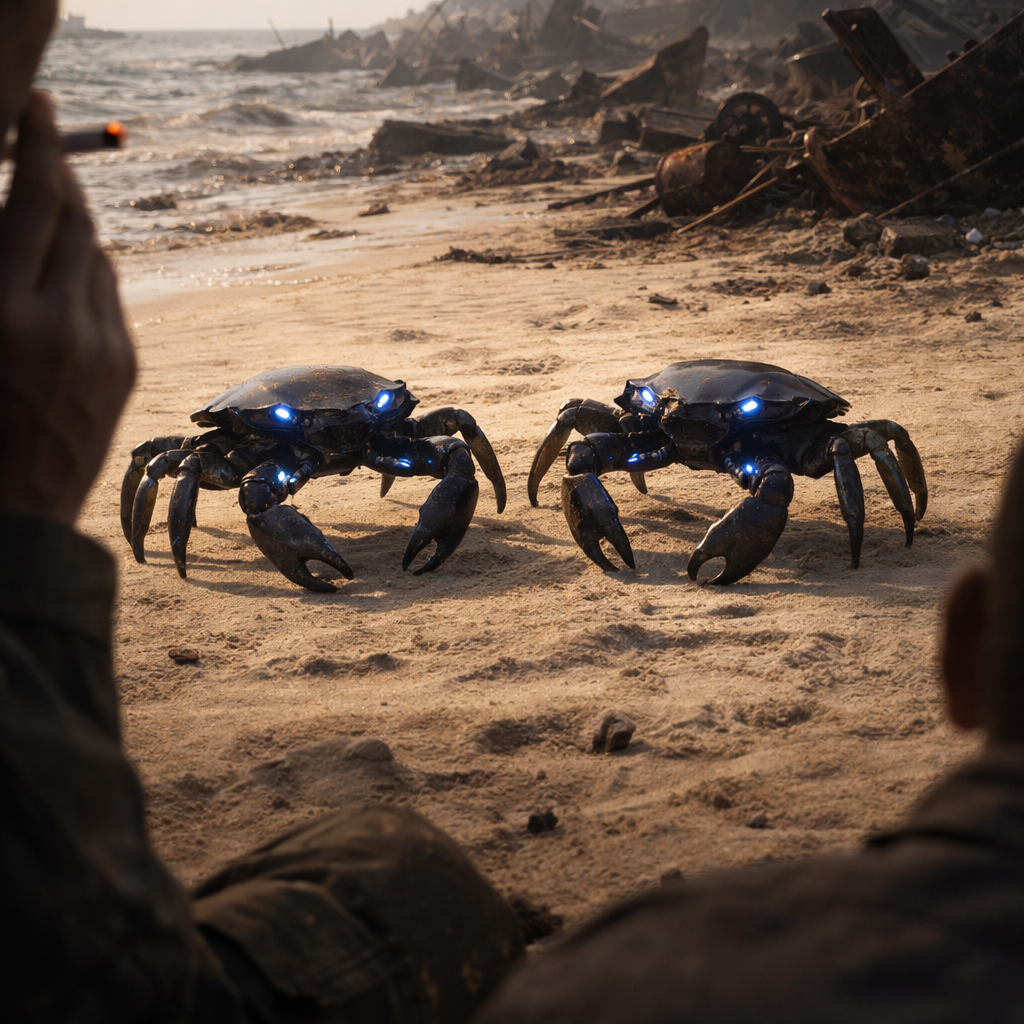
It was the size of a shoe. The shape of a crab, made from a metal that absorbed light rather than reflected it. No visible cables, no key, no fuel intake. It sat in its casing like something that had been waiting patiently and had long since stopped being impatient about it.
“What the hell is this.” Krüger’s voice was flat. He looked at it the way he looked at equipment failures. “They’re sending us novelties.”
There was some laughter. Someone suggested it was an ironic gift from high command. The engineers, men accustomed to dynamos and vacuum tubes, shrugged and walked away. If it had no motor, it wasn’t a machine. If it wasn’t a machine, it wasn’t their problem.
They left it on a granite block in the open sun.
Simón didn’t leave.
The sun hit the object at noon and the air around it seemed to contract slightly, as if the heat were being pulled inward. No clicking, no gears — a low frequency that Simón felt first in his back teeth and then in his sternum. The joints of the crab lit up cold and blue, a chemical light that had no business coming from metal.
The legs, which had appeared fused to the body, extended. The motion was fluid in a way that made Krüger step back and put his hand on his holster out of reflex. The claws opened and closed with a dry, rhythmic sound that nobody could categorize.
There was no operator. There were no wires. Just sunlight going into the metal and coming out as movement.
The laughter on the beach was already gone.
Krüger looked back at the crate lying in the sand. Read the inscription again.
“What does it do,” said Halberg, in a voice that had lost its academic register entirely.
Nobody answered. The small crab had already turned toward the south beach.
It moved with a precision that was almost inappropriate given its size. Under the vertical midday light it went to work on the wreckage the way a professional goes to work — no hesitation, no surveying, no false starts.
The first thing it touched was a Stuka engine block. It extended a claw and separated aluminum from cast iron with a sound like paper tearing. No lever. No visible effort. The metal simply yielded.
Nobody moved. The guard sergeant had a cigarette halfway to his lips and held it there. The technicians stood at the edge of the sand and said nothing.
“The piles,” said Elsa Weiss, without lowering her field glasses.
She was right. The crab wasn’t just stacking debris. It was tapping each piece with a front leg, listening to something, and then dragging it to a specific location: stainless steel in one column at the back, cast iron in graduated blocks near the waterline, copper and aluminum in separate pyramids at a precise distance from each other. A chemical taxonomy. Forty-kilo pieces moved across the sand like they’d forgotten how heavy they were.
“Dr. Halberg.” Krüger’s voice came out rougher than he’d intended. “Tell me where the torque is coming from. There are no pistons. There’s no exhaust.”
Halberg didn’t answer. He was counting under his breath, trying to find the math of the sorting rate.
Simón watched the tracks the legs left in the sand. Not the impression of a heavy machine. Barely a trace, like something that was mostly suggestions of weight.
That night nobody talked about the war.
Krüger noticed it late, with the food already cold and the bunker lamps turned down. The men were still at the table, which was unusual, talking with a mood he hadn’t heard from them in months. Not the nervous relief of a near-miss and not the edgy high of a win. Something quieter.
“What I can’t work out,” one of the technicians was saying, leaning over the table, “is how it tells duraluminum from regular aluminum. I need a spectrometer for that.”
“What gets me is the speed,” said another. “I ran the numbers. At that rate it moved close to four tons this afternoon.”
“Five,” said Halberg from the back, without looking up.
A pause. Then something between a laugh and a sound of defeat.
“Never thought I’d see the south beach sorted by alloy,” the sergeant said. He shook his head slowly.
Krüger listened to all of it without participating. He went to bed before the others but didn’t sleep for a long time.
Elsa Weiss always went out before dawn. She’d had the habit somewhere before this island and kept it here because the early hours were the only quiet ones.
That morning the air smelled different. She walked a few steps before she understood it: clean metal. Not the chronic oxidation smell of the south beach, not salt mixed with old grease. Fresh-cut surfaces. Something recently touched.
She stopped at the edge of the path and looked down.
The south beach was unrecognizable.
It wasn’t just that the scrap was organized. The organization followed a logic she recognized as chemical: each pile separated from the next by a distance that accounted for conductivity, for humidity, for proximity to the tide. Stainless steel at the back, away from moisture. Copper elevated, out of the reach of the waves. Cast iron closest to the water, as if something had calculated that was where it lost the least.
The crab wasn’t there.
She searched with her field glasses. The island at that hour was all similar shadows, and something the size of a shoe could look like any fragment of basalt. She walked north along the waterline and back. Checked the granite outcrop. Nothing.
She found it at the water’s edge.
It was still, right where the foam came and pulled back. She crouched and picked it up carefully, though everything it had done the day before suggested careful wasn’t necessary. She turned it over.
No legs. No claws. The shell was intact, the same light-absorbing metal, but everything that had moved was gone. Just the shape remaining, the hull of something that had been more.
Then she saw the light.
Red, small, on the underside of the shell. Pulsing with a slow and regular rhythm. Elsa watched several cycles of it. She didn’t have a word for what it looked like that wasn’t the wrong word, so she didn’t use one.
She set it back in the sand exactly where she’d found it. Stood there a moment. Then went up to the bunker.
Everyone was already awake. The smell of bad coffee. Someone had turned on the radio that only got static.
“The crab’s on the shore,” Elsa said when she came in. “It worked through the night. Reached the north beach too. It doesn’t have legs anymore. Just the shell. There’s a red light on the underside that’s blinking.”
The silence that followed was different from the silences of the day before.
Halberg set his cup down slowly. Krüger, who had been standing with his back to the room looking at the duty map, didn’t turn around right away. Simón stopped chewing.
“Are the legs on the beach?” Halberg asked.
“No,” Elsa said. “They’re not anywhere.”
Nobody said the obvious thing out loud. They were all thinking it.
Krüger turned around. He looked at Elsa, then at the window.
“Nobody touches it,” he said.
Simón was in the doorway with his coffee when he looked toward the shore, not for any particular reason. The shell was where Elsa had left it. But it wasn’t still.
The legs were back.
He hadn’t seen the moment. No sound, no visible transition. Where there had been a legless hull with a blinking red light there was now a crab standing on wet sand, joints extended, red light off. As if the night had simply been a night. As if rest was something it also needed and did without asking.
They watched it turn — that orientation they already knew — toward the piles, toward the work, and start moving. Then the sounds began.
Not the methodical sorting of the day before. This was different: intermittent arcs, the sharp scrape of metal on metal, an irregular cadence. The crab was pulling pieces from different piles — steel, copper, a section of what looked like a motor housing — and bringing them to a central point it had cleared in the sand.
“Different agenda today,” Elsa said, not taking her eyes off it.
Simón nodded slowly. He was watching the claws, the selection they were making, which didn’t seem random in any direction.
“It’s taking from all the piles,” he said. “Not just one.”
Elsa moved gradually closer, the way you move toward something that might startle, though nothing the crab had done suggested it registered them at all. She stopped about a meter and a half away and leaned forward to see what it was working on, and she didn’t notice — none of them noticed until it happened — that her shadow had fallen across the crab.
The crab didn’t stop. It shifted.
Three lateral steps to the right, into direct sun, and continued exactly where it had left off.
Elsa straightened up. She looked at her shadow in the sand. Then at Simón.
Simón was already moving. He positioned himself on the other side, angled his shadow over the crab deliberately. Same result: three steps, reposition, back to work.
He did it twice more, varying the angle.
Each time.
He stood still, watching the point of concentrated light on the crab’s shell when the sun hit it directly. It wasn’t evasion. It wasn’t a defensive response.
“It’s not avoiding us,” Simón said. “It’s just correcting for us.”
Nobody asked what he meant. They’d all reached it at the same time.
Halberg was the first to find paper.
Not a proper notebook — the back of a ventilation schematic, the first thing out of his pocket — and he started writing in the cramped hand of someone afraid the thing he’s documenting will stop before he gets it all down. Nobody made fun of him for it. Nobody had a better idea.
The crab had been working on the central point for two hours.
“It’s welding,” said the young technician, with a certainty that sounded almost offended. “No visible electrode. No external current source. But that’s exactly what’s happening.”
“The heat comes from the claws,” Simón said. “The joints go the same blue as when it first activated.”
“Blue is too cold to weld steel,” the technician said.
“Yeah,” said Simón. “I know.”
Nobody continued that thread. There were too many impossible threads and only one morning to pull them.
What it was building was hard to see in the first hours because it didn’t work linearly. Not from the ground up the way a man with tools would. It worked in simultaneous layers, touching one point, then another distant one, then returning to the first with a new piece, solving several problems at once. Elsa tried to sketch it twice and both times the sketch was obsolete before she finished the line.
“It’s a base,” Halberg said, bent over his notes. “What it’s fixing to the center is a base. Those two pieces of cast iron — do you see the angle? It’s the same angle as the crab’s own front legs. Exact.”
Silence.
“Say that again,” Krüger said from behind him.
Halberg didn’t repeat it. He pointed with his pencil and let the others get there themselves.
They got there at the same time and nobody spoke for a long minute.
By mid-morning the shape was unmistakable.
Eight articulations in progress. Two longer front structures. A central mass of a compound metal that none of them could name. The crab moved around the construction with an attention that was almost anxious, checking angles, adjusting things with its claws that were invisible from where they stood.
“It’s using copper for the joints,” Elsa said quietly. “Copper at every articulation point. Steel for the shell. Aluminum for…” She stopped.
“For the legs,” Simón said.
“Its legs are aluminum too.”
The young technician had sat down in the sand without realizing it. He was watching with his elbows on his knees, the expression of someone mentally reviewing everything he thought he knew about metallurgy and finding it didn’t add up.
Halberg kept writing. His notes had stopped being description. They were questions now.
Then the new thing moved.
“Stop,” Elsa said, in a voice quiet enough that it took a second to cut through. “Look at the front legs.”
The structure — which until that moment had been an assembly of inert metal on the sand — flexed both front legs slowly, as if calculating the weight of the world before deciding whether to stand. Extended them. Drew them back.
The original crab went still.
Completely still, claws low, sensors forward. Not the stillness of something switched off. Something waiting.
The construction extended its legs a second time. This time it didn’t draw them back.
It stood up.
Identical. Not similar, not approximate. The same shell absorbing light instead of reflecting it, the same proportions, the same angle of the claws at rest. Two crabs on the sand where that morning there had been one, twenty centimeters apart, neither doing anything to close the distance.
Nobody on the beach spoke.
The sergeant had a cigarette halfway to his mouth and left it there. Halberg had stopped writing. The young technician, still sitting in the sand, stared with his mouth slightly open — the look of someone who’s just seen something they’ll spend the rest of their life trying to describe accurately.
Simón looked at Elsa. Elsa watched the two crabs.
“Two,” she said softly, as if naming it could undo it.
The storm didn’t announce itself.
They’d been on the island for weeks without anything more threatening than boredom, and when the sky started changing color in the early afternoon nobody read it correctly until there was nothing left to read. The sergeant shouted first. Then the wind took all the sound and there was nothing except wind.
The bunker held for four minutes.
Simón would not remember the collapse as a continuous event but as disconnected images: the north corridor ceiling giving at an impossible angle, Elsa pressing herself against the wall with her arms over her head, the main generator sliding off its foundation as if the floor had decided to tilt. Then dust. Then dark. Then a silence he needed a moment to understand was outdoor silence, because there was no longer an indoors.
They came out through a gap that hadn’t been a door.
The island was different.
Not gradually different — replaced. Same geography, none of the same details. The auxiliary structures were rubble. The radio mast had folded over itself. The granite on the south beach, which had served as the first crab’s work surface, was buried under a meter of displaced sand.
They walked without talking. There was too much to take in and the mind can only process loss at a certain speed.
Krüger was gone. Halberg was gone. The young technician, the sergeant, the others: gone. Simón knew before he searched and searched anyway, because not searching would have been its own kind of collapse.
Elsa waited without telling him to stop.
She was the one who looked at the south beach first.
She didn’t say anything right away. She stood at the edge of the path with her arms crossed, looking, and Simón didn’t notice she’d stopped walking until he was several steps ahead of her. When he followed her line of sight he went quiet too.
The scrap was gone.
Not scattered by the storm, not buried under new sand. Gone. The sorted piles the first crab had spent a day organizing — the steel columns, the copper pyramids, the iron blocks graduated by weight — all of it. The sand was clean in a way the wind alone couldn’t explain. No rust residue. No drag marks. No sign that four tons of metal had spent years on that beach.
In its place: crabs.
Dozens of them, distributed across the south beach and beyond, toward the north shore and the basalt outcrops and the edges of what had been the camp perimeter. All the same size. All the same light-absorbing metal. All working with that silent, total concentration Simón had come to recognize and had not gotten used to.
None of them looked up.
“How many,” Simón said, though he was barely speaking to her.
Elsa didn’t answer. She’d started counting and stopped because the number kept moving.
Simón walked down to the waterline and crouched where the iron pile had been. The sand was cold. Smooth. No oxide residue, no marks, as if the pile had never been there or had been gone for much longer than he remembered.
He stood up and looked at the length of the beach.
“Not even shavings,” he said. His voice sounded small. “Not even filings.”
The crabs went on working.
Elsa counted eighty-six before she lost the number.
They didn’t make it easy — they moved, overlapped, disappeared behind basalt outcrops and reappeared elsewhere. Simón had given up counting and was just looking at the extent of it all with the expression she’d come to recognize as his mechanic’s face: confronted with something that has no manual.
He was the one who noticed first.
“Elsa.”
Three crabs had separated from the group and were moving in a straight line toward where they stood. Not the lateral, precise choreography of work. Something else. Direct.
“They’re coming toward us,” Simón said.
“I see that.”
Neither of them moved immediately, which was partly surprise and partly the fact that for all the days previous the crabs had ignored them with such absolute consistency that moving would have felt like an overreaction. They stayed still and let the three approach, the same wrong logic you use when you stand still in front of something that has never given you a reason to be afraid.
The three stopped less than a meter away.
The clicking started.
Not work sounds — not the scrape of metal on metal or the low hum of the hot claws. Dry, rhythmic, urgent. The three of them clicking in unison, a metallic percussion that bounced off the basalt and filled the air with something that didn’t need translating.
“What do they want,” Elsa said, quietly, as if the volume mattered.
Simón shook his head. He was watching the claws. He was watching the sensors oriented directly toward them — the first time in all these days the crabs had decided humans existed.
“I don’t know,” he said. “But something.”
He took one step back.
That was enough.
The outer two moved at a speed that had no relationship to anything they’d done before. No warning, no gradual acceleration. They were still and then they weren’t, and in the space between those two states Simón was already on the ground.
He didn’t know how he’d fallen. He felt the impact of the sand, then weight on his chest, then weight on his legs, and when he tried to get up he understood that the two crabs had pinned him with a precision that wasn’t violent in any way he knew how to name. No pain yet. Just an absolute stillness, as if the ground had decided to hold him.
The third moved toward his face.
Elsa didn’t think. She grabbed it with both hands and pulled. The shell didn’t give. The claws rotated toward her hands and she felt the edge before she saw the blood — a clean cold cut across her right palm that made her drop it by reflex. She grabbed again with her left. Another cut. The crab wasn’t looking at her. Its sensors were trained on Simón with a focus that was almost clinical.
Simón was fighting the other two. They were heavier than they appeared, or he was weaker than he thought. He got his right arm free and hit the one on his chest. Like hitting an engine block.
Elsa picked up a rock and hit the crab’s shell twice with a force that shuddered up to her shoulder. Nothing. No crack, no dent, no acknowledgment.
The crab at Simón’s face wasn’t going for his throat.
That took a moment to register, because fear organizes information only one way and she had assumed the worst. But the claws weren’t finding his carotid. They were working toward his jaw. Opening toward his mouth with a brutal efficiency while Simón fought and turned his head and couldn’t do either fast enough.
“Your mouth,” Elsa said. “It wants your mouth.”
Simón looked at her for a moment. His eyes asked a question that didn’t get to form.
The claws found what they were looking for.
It wasn’t surgical. That was the worst part — that it wasn’t surgical. Something capable of separating aluminum from duraluminum by resonance, capable of welding without visible electrodes, capable of building a replica of itself from scrap: and what it did next had none of that precision. As if precision was a choice and this didn’t require it.
Elsa looked away and looked back because looking away didn’t change what she was hearing.
Simón stopped fighting sooner than she expected.
When the third crab pulled back it held in its claws what it had come for: two molars and a crown, surgical silver, the same metal Simón had been carrying in his mouth since before the war, since before the island, from a life that had taken place somewhere else entirely. It set them in the sand with the same care the first crab had used when laying sorted pieces in their correct piles.
The other two released Simón and stepped back.
All three turned and went back to work.
Elsa knelt in the sand.
There was nothing to do and she did things anyway, because the body needs to do something when the mind has no instructions. Her hands were still bleeding. The beach was full of crabs working. The sun was exactly where it had been.
She looked at the three silver pieces in the sand, twenty centimeters from Simón’s head.
It had needed them. That was the sum of it. Needed them for something she didn’t understand yet, and taken them the most direct way available, with the same logic the first crab had used on the Stuka engine or the propeller. No malice. No awareness of what it was taking.
That was, somehow, the hardest part to hold.
She stayed kneeling for a time she didn’t measure, palms open on her knees, blood drying in dark lines, surrounded by machines that didn’t know she was there. Alone on an island that didn’t appear on standard nautical charts. No radio. No shelter. No one else.
The first two days she didn’t go outside.
She’d found a corridor in the north wing of the bunker that the collapse had left intact by accident — three meters between two walls that were still holding, a stretch of ceiling she checked every morning for new cracks. There were new cracks every morning. She marked them on the wall with a piece of plaster because she needed to do something with her hands and that was the only gesture that resembled control.
She found water in a cracked pipe from the auxiliary tank. Not much. Enough to keep from making decisions yet.
She’d buried Simón herself, or tried. The south beach sand didn’t cooperate — it collapsed back in on itself — and in the end she did what she could and left without looking back, because her body wasn’t offering her the option.
At night she heard the crabs working. The sound came through the basalt and the rubble, muffled, and in the first days she woke up at every pulse of vibration and took several seconds to remember where she was. Then she stopped waking. She learned to sleep inside the sound the way you sleep inside rain when you have no other choice.
The hunger was a problem she hadn’t solved.
The fear was a problem she’d stopped trying to solve.
On the fifth day the cracks in the ceiling had progressed past the point of pretending, and Elsa Weiss had spent her whole life being incapable of lying to herself about what her eyes were seeing.
She sat with her back against the most solid wall and thought for a long time, not rushing, because thinking was the one thing she still did well and the island wasn’t going to take that from her too.
She had to get out. Getting out meant the beach, and the beach meant the crabs, and the crabs meant a conversation she didn’t know how to have with something that didn’t recognize the languages she spoke. What had happened to Simón was a material extraction. Not an attack, not a sentence. An extraction. She’d thought that many times in five days without it becoming any easier to hold or any more useful.
But it was information. And she was a scientist before anything else.
She woke to sounds she recognized before she opened her eyes.
Not the muffled beach noise. Claws, close. Arc welding. Metal yielding under pressure. Inside the bunker.
She went completely still.
The dark corridor now had a pulse of blue light coming from the central hall, intermittent and cold, drawing long shadows across the cracked ceiling. Elsa pressed herself against the wall and moved centimeter by centimeter toward the edge of the corridor, toward the point where the passage opened onto what had been the main room.
She looked.
Four of them. But not the crabs she knew.
These were large. Not shoe-sized — table-sized. The shell at knee height, claws with the reach of an extended arm. They moved with the same precision as before but at a scale that changed something fundamental in how the brain processed them. What in the small ones was delicacy was in these something else: contained power, the difference between seeing a scalpel and seeing the same blade in a much larger hand.
They were working in the center of the room.
It took her several seconds to understand what she was seeing, and when she understood it she had to put her hand on the wall because her knees weren’t reliable.
One of the four was motionless in the center.
The other three worked on it with an efficiency that had none of the hesitation she’d observed in earlier phases. They knew exactly what they were after. They were disassembling the fourth with the same logic the first crab had used classifying scrap — each component separated, each alloy identified and allocated, nothing wasted.
From the materials of the fourth, something new was being built. Larger still. Elsa couldn’t see the complete shape from her angle, but she could see the scale of the pieces, the diameter of the joints being assembled. Whatever was being built in the center of what had been her shelter was to the large crabs what the large crabs were to the first one.
Another step. On a staircase she couldn’t see the bottom or the top of.
The corridor was no longer shelter. Her mind processed that with a flatness that would have surprised her a week ago. There was nowhere to retreat to that wasn’t worse than what was in front of her.
She crouched against the dark wall and thought.
The south wing had an exit the collapse had partially blocked but not sealed. She’d checked it on day two. Three minutes at a run if the crabs were occupied. From there to the north headland, where they seemed less concentrated. After that — something. There were remnants of the radio mast. There were options. There were variations on the same verb: survive one more day.
She looked back at the blue light pulsing from the central room. Listened to the sounds of something being taken apart to build something larger.
She thought about Halberg writing on the back of the ventilation schematic. She thought about the young technician sitting in the sand with his elbows on his knees. She thought about Simón saying it’s correcting for us, in that low voice of someone who’s just understood something they’d rather not have.
She thought about the three silver pieces set in the sand with perfect care.
She picked up from the floor the steel pipe she’d been using as a pry bar since day two. Weighed it in her hand.
And walked toward the light.
She didn’t move until three in the morning.
Not because she had a watch, but because she’d spent enough nights on this island to learn its rhythms. The beach sound changed as the night deepened — slower, more spaced, like a collective breathing settling toward something like sleep. She’d learned that shift without meaning to, the way you learn the sounds of a house you’ve lived in too long.
When the silence was complete she came out of the corridor and walked to the beach.
The crabs were still.
All of them. The eighty-some she’d tried to count that last day she’d had someone to count with. Distributed across the south and north beaches, on basalt and at the waterline, each one stopped exactly where the night had found it working. None had moved to shelter. They’d simply stopped, the way a factory stops when the power goes, without transition, without shutdown protocol.
And they were all blinking.
Red lights at ground level, eighty small patient lights opening and closing with the same slow beat across the whole beach — a single heart multiplied, waiting for the sun. It was almost beautiful. Elsa let herself think that, and then got to work.
She had a few hours and almost nothing to work with.
She went through the bunker rubble with a flashlight whose battery wasn’t going to last, and collected what she found: three iron pipe sections, two aluminum plates from the comms panel, a length of copper wire, bolts and screws from the corridor floor, and the steel pipe she hadn’t put down.
She brought it all to the threshold of the central wing.
Then she built the path.
Not visible to a human eye. A line of small metal fragments running from the north beach to the entrance of the central wing, spaced according to what she’d spent days observing — close enough together that something navigating by resonance would read them as a continuous signal, varied enough in composition to be irresistible. Steel next to copper next to aluminum. Each combination she’d watched be sorted with the most urgency, now mixed deliberately, a disorder that for the crabs had to be what the smell of food is to something that hasn’t eaten.
At the end of the path, in the center of the wing, she left everything else in a pile.
The steel pipe she positioned last, set against the wall at the point of the crack she knew by touch. Already in place.
Then she waited.
She found cover behind the basalt shelf at the north entrance, outside the line of the path and outside the angle of any sensor. The three-in-the-morning cold was the island’s damp cold, the kind that moves through clothes, and Elsa held still against it because moving was the one thing she couldn’t afford.
The first crab found the path sooner than expected.
From her angle she only saw the red light stop blinking, the legs articulate, the orientation shift. She watched it follow the first fragment to the second, second to third, front leg touching each piece and listening to what the metal said.
It went into the wing.
The second followed four minutes later. Then the third and fourth almost together. Then more she couldn’t count because the dark hid them and she only knew they were moving by the red lights going out across the beach.
She waited.
She wanted all of them inside, or enough of them that none capable of digging out the others would be left when the sun rose. She kept counting the lights going dark, kept calculating, kept still with her back against the cold basalt and her fingers around the pipe.
When the beach went dark she waited ten more minutes.
Then she went in.
The central wing was a cavern of red light.
They were moving through the interior along the path toward the pile, dozens of them at various stages of the route, some still at the entrance, some already at the pile with active claws, all with that absolute concentration that was their only mode of being. None of them raised their sensors.
Elsa reached the east wall without breathing.
She found the crack by memory — she’d run her fingers over that angle enough times to find it blind, which was exactly what she was doing now. She set the pipe. Took a breath.
And pushed.
The wall didn’t hold long. The main beam had been giving for days and the weight of the crabs on the fractured floor had done the rest. The sound was the same resigned, stomach-level sound as before but faster, as if the building had been waiting for a good enough reason.
Elsa was already running.
She came out through the south wing in four seconds and kept running until she hit the tide line, as far as her legs would take her, and when she turned the central wing was already gone, collapsed into itself in a cloud of dust and concrete that the dawn wind was slowly carrying out to sea.
She stood with her feet in cold water.
The beach was dark. No red lights. No hum. No sound of metal being sorted, no arc welding, no click of claws. Only the waves, and the dust settling, and the most complete silence she’d heard since she arrived.
She waited.
Nothing moved in the rubble.
When the sun came up Elsa was still at the waterline.
She’d spent the remaining dark sitting in the sand with her knees to her chest, watching the rubble, waiting for blue light in the cracks. None came. The concrete was still and the island was still and the sun rose over all of it and found nothing to wake.
She closed her eyes.
She opened them.
She got up, brushed the sand off her clothes, and looked at the south beach for the first time without counting crabs. It was just a beach. Basalt, salt air, the scar where the metal piles had been. An ugly island the Pacific had produced without intention, which was now, for reasons no report would be able to explain correctly, entirely hers.
She was hungry. Her palms were scarred and her clothes were ruined and she had no way to communicate with anyone and a survival problem that started right now.
She walked toward the water.
First thing: eat. Second: find a way to make someone know where she was. Everything else could wait.
Elsa Weiss had survived enough this week to know that problems look different in daylight — and that the sun, which she’d never given much thought to before any of this, was for the moment the only guarantee she had that nothing under that rubble was going to start up again.
She planned to keep it close.